
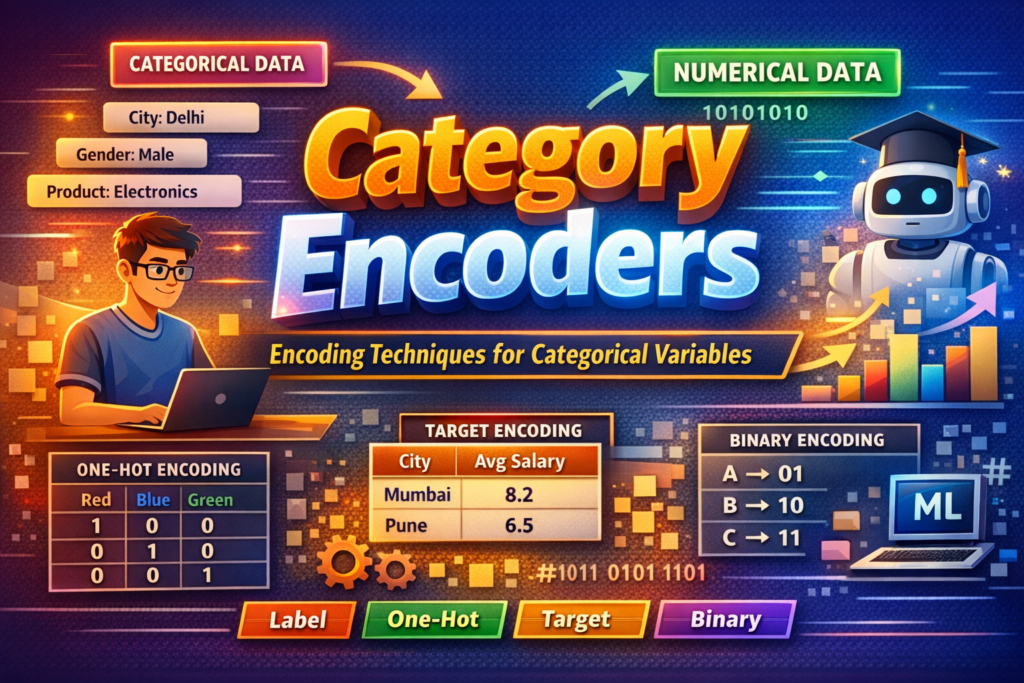
Real-world datasets are full of categorical variables:
City: Mumbai, Pune, Delhi
Education: Graduate, Post-Graduate
Product Type: Electronics, Clothing, Grocery
Browser: Chrome, Safari, Firefox
However, machine learning models work with numbers, not text.
This is where Category Encoders come into play.
Category Encoding is the process of converting categorical (text/label-based) data into numerical representations that ML algorithms can understand.
This article explains:
Why encoding is necessary
Popular encoding techniques
When to use which encoder
Pitfalls to avoid
Best practices used in industry
Types of Categorical Variables
Before choosing an encoder, understand your data type:
1️⃣ Nominal Categories (No Order)
Examples:
Gender: Male, Female
City: Delhi, Pune, Chennai
No inherent ranking
2️⃣ Ordinal Categories (Ordered)
Examples:
Education: High School < Graduate < Post-Graduate
Rating: Poor < Average < Good < Excellent
Order matters
Why Category Encoding Is Important
Without encoding:
Models cannot compute distances or splits
Algorithms may crash or behave unpredictably
Proper encoding helps:
Improve model accuracy
Reduce bias and overfitting
Handle high-cardinality features
Build scalable ML pipelines
Common Category Encoding Techniques
1️⃣ Label Encoding
What it does:
Assigns each category a unique integer.
| Category | Encoded |
|---|---|
| Red | 0 |
| Blue | 1 |
| Green | 2 |
Pros
Simple and fast
Memory efficient
Cons
Introduces false order
Dangerous for nominal data
Best Use Case
Ordinal variables with real ranking
2️⃣ One-Hot Encoding (OHE)
What it does:
Creates a new binary column for each category.
| City | Delhi | Pune | Chennai |
|---|---|---|---|
| Delhi | 1 | 0 | 0 |
| Pune | 0 | 1 | 0 |
Pros
No ordering bias
Works well with linear models
Cons
Curse of dimensionality
Poor performance with many unique values
Best Use Case
Nominal features with low cardinality
3️⃣ Ordinal Encoding
What it does:
Maps categories based on logical order.
| Education | Encoded |
|---|---|
| High School | 1 |
| Graduate | 2 |
| Post-Graduate | 3 |
Pros
Preserves ranking
Compact representation
Cons
Incorrect ordering leads to wrong predictions
Best Use Case
Ordinal variables with clear hierarchy
4️⃣ Target Encoding (Mean Encoding)
What it does:
Replaces categories with mean of target variable.
| City | Avg Salary |
|---|---|
| Mumbai | 8.2 |
| Pune | 6.5 |
Pros
Handles high-cardinality features
Powerful for tree-based models
Cons
Risk of data leakage
Overfitting if not regularized
Best Use Case
Large datasets
High-cardinality categorical features
5️⃣ Frequency / Count Encoding
What it does:
Encodes categories based on frequency.
| Browser | Frequency |
|---|---|
| Chrome | 0.65 |
| Safari | 0.20 |
| Firefox | 0.15 |
Pros
Simple
No dimensional explosion
Cons
Loses category semantics
Best Use Case
When frequency itself is informative
6️⃣ Binary Encoding
What it does:
Combines label encoding + binary representation.
Example:
Category → Label → Binary
A → 1 → 001
B → 2 → 010
C → 3 → 011
Pros
Reduces dimensions
Efficient for high cardinality
Cons
Less interpretable
Best Use Case
High-cardinality categorical variables
7️⃣ Hashing Encoding
What it does:
Applies a hash function to categories.
Pros
Extremely memory efficient
No need to store mapping
Cons
Hash collisions
Not human-readable
Best Use Case
Streaming data
Very large datasets
Category Encoders in Python
Most encoders are available in:
scikit-learn
category_encoderspackage
Common encoders:
OneHotEncoder
OrdinalEncoder
TargetEncoder
BinaryEncoder
HashingEncoder
Choosing the Right Encoder (Quick Guide)
| Scenario | Recommended Encoder |
|---|---|
| Small categories, nominal | One-Hot |
| Ordered categories | Ordinal |
| High cardinality | Target / Binary |
| Streaming / Big data | Hashing |
| Tree-based models | Target / Frequency |
Common Mistakes to Avoid
❌ Label encoding nominal features
❌ Applying target encoding before train-test split
❌ One-hot encoding high-cardinality columns
❌ Ignoring unseen categories in production
Best Practices (Industry-Ready)
✔ Always split data before encoding
✔ Use pipelines for reproducibility
✔ Regularize target encoding
✔ Handle unknown categories gracefully
✔ Evaluate encoding impact using cross-validation
Real-World Example
In an e-commerce ML model:
Product Category → One-Hot
City → Target Encoding
User ID → Hashing
Rating Level → Ordinal Encoding
This hybrid strategy balances accuracy + performance
Key Takeaways
Encoding is not optional in ML
No single encoder fits all problems
Understanding data type + model is crucial
Proper encoding can dramatically improve results