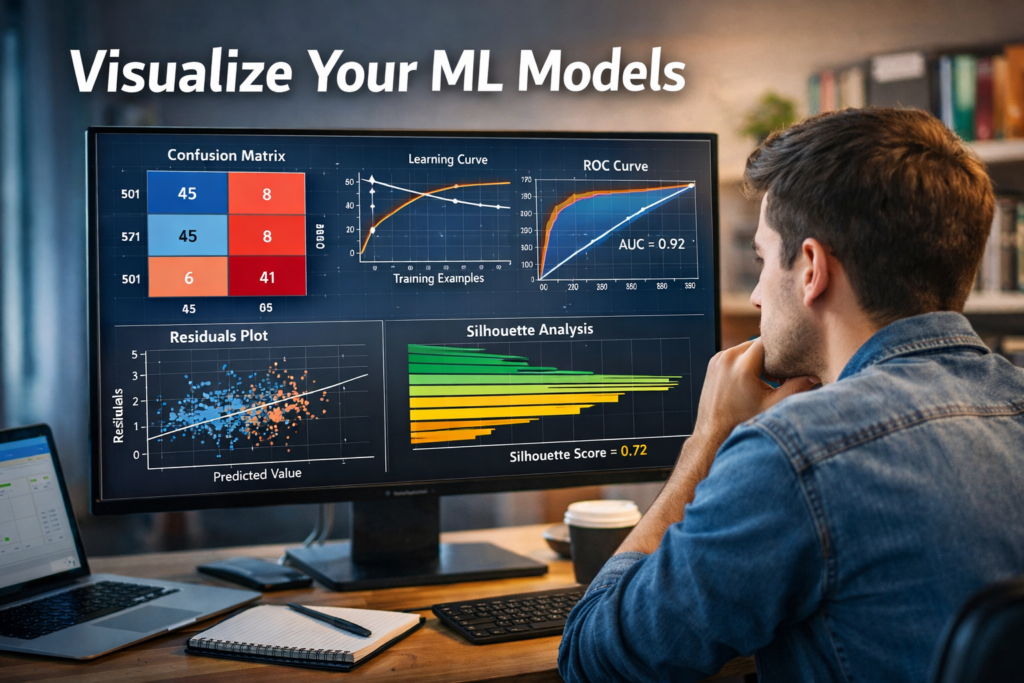
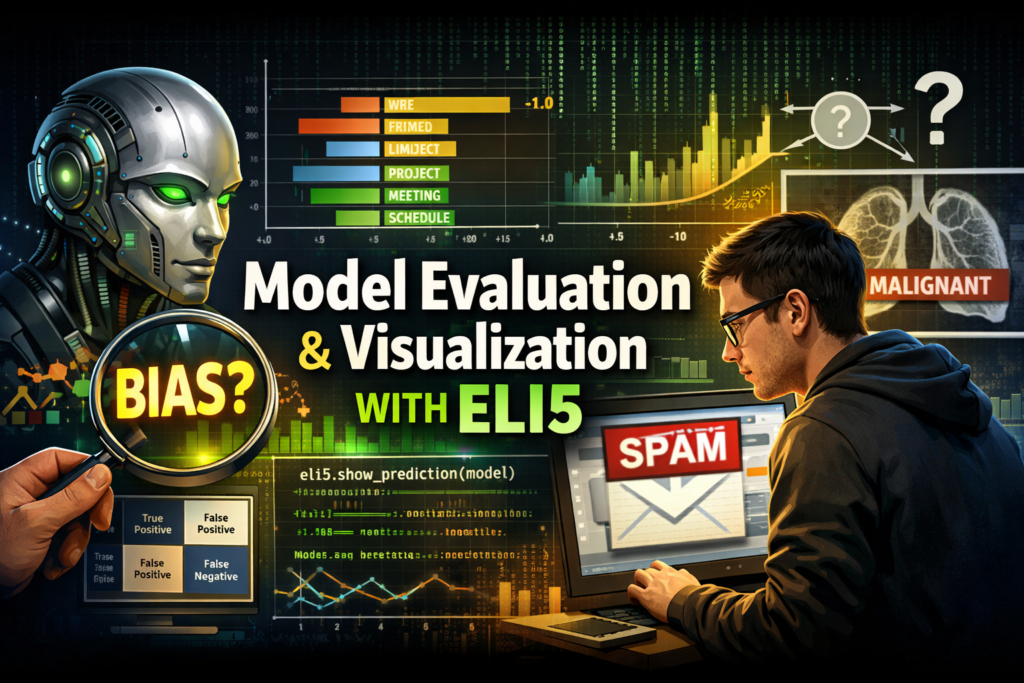
Model Evaluation & Visualization with ELI5

Debugging and Understanding ML Classifiers Clearly The Real Problem: Accuracy Is Not Enough Most students stop here: “My classifier gives 91% accuracy. Model is good.” But in real-world ML systems, accuracy alone is dangerous. Imagine: A bank rejecting loans A healthcare model predicting cancer A hiring system filtering candidates Now ask: Why was this decision …

Model Evaluation & Visualization with ELI5 Read More »

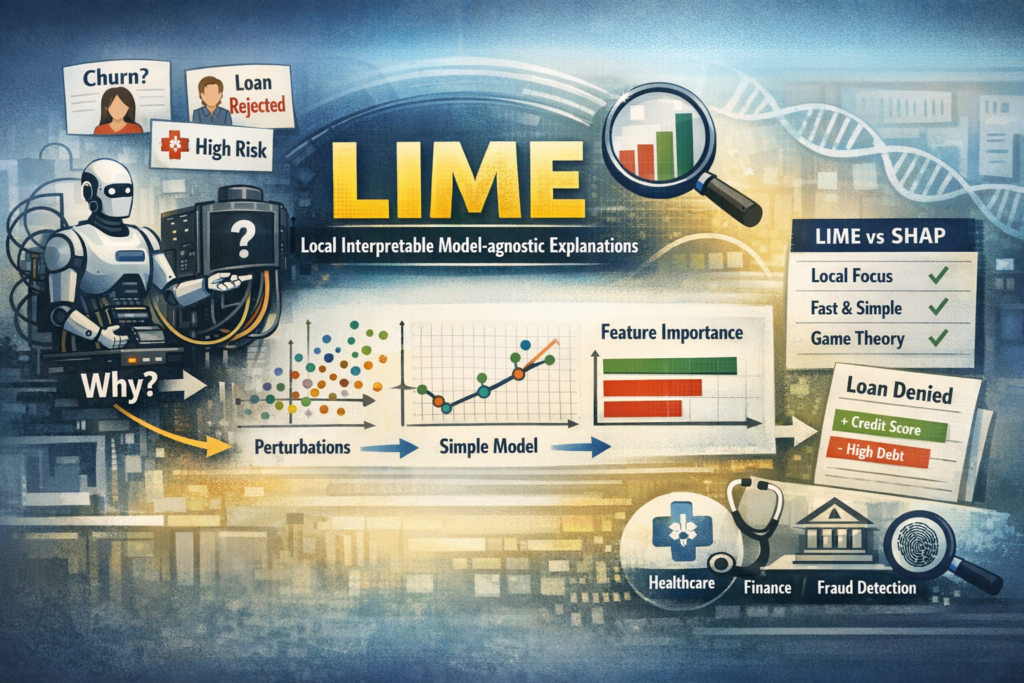
Model Evaluation & Visualization with LIME

 1. Why Do We Need LIME? Imagine this situation: Your ML model predicts:  A customer will churn  A loan application will be rejected  A medical patient has high risk The first question stakeholders ask: “Why did the model make this prediction?” Accuracy is not enough anymore. Modern ML systems require: Transparency Trust Fairness Debugging capability …

Model Evaluation & Visualization with LIME Read More »

Model Evaluation & Visualization with SHAP

Why Explainability Matters Imagine this situation: Your ML model predicts that a student will fail an exam or a loan will be rejected. The next question is unavoidable: Why did the model make this decision? Accuracy alone is no longer enough.Modern ML demands interpretability, trust, and accountability. This is where SHAP (SHapley Additive exPlanations) becomes …

Model Evaluation & Visualization with SHAP Read More »

Model Evaluation and Visualization with Yellowbrick

***Visual Analysis and Diagnostics for Machine Learning Models***  Introduction Building a machine learning model doesn’t end when training is complete.A trained model without evaluation is like a student who took an exam but never saw the results. This is where model evaluation and visualization become critical. Yellowbrick is a powerful Python library that helps us: …

Model Evaluation and Visualization with Yellowbrick Read More »

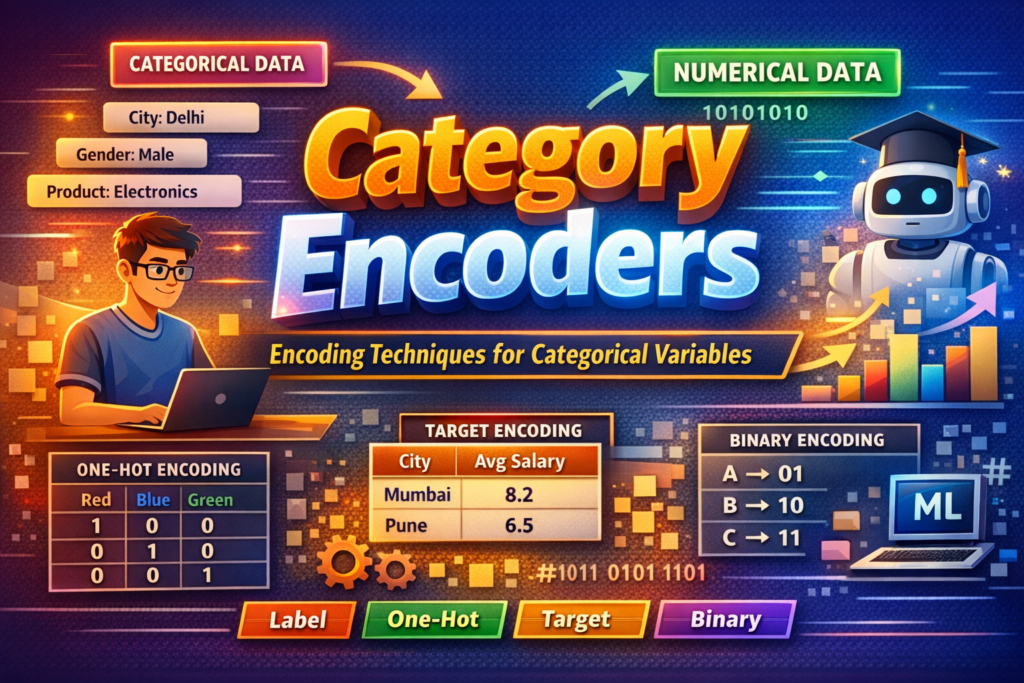
Category Encoders: Encoding Techniques for Categorical Variables

Real-world datasets are full of categorical variables: City: Mumbai, Pune, Delhi Education: Graduate, Post-Graduate Product Type: Electronics, Clothing, Grocery Browser: Chrome, Safari, Firefox However, machine learning models work with numbers, not text.This is where Category Encoders come into play. Category Encoding is the process of converting categorical (text/label-based) data into numerical representations that ML algorithms …

Category Encoders: Encoding Techniques for Categorical Variables Read More »

Feature Engineering for Machine Learning Using scikit-learn Pipelines

Feature Engineering Techniques Compatible with scikit-learn In real-world Machine Learning projects, model performance depends more on features than on algorithms. Even the best model will fail if: Features are noisy or poorly scaled Categorical data is encoded incorrectly Important patterns are not exposed This is why Feature Engineering is considered the art + science of …

Feature Engineering for Machine Learning Using scikit-learn Pipelines Read More »

Data Processing and Feature Engineering with Dask

As datasets grow from MBs → GBs → TBs, traditional tools like Pandas begin to struggle: Runs out of memory Slow execution on large datasets Single-core processing bottleneck This is where Dask becomes a game-changer. Dask allows you to: Process large datasets that don’t fit into memory Scale computations across multiple CPU cores or machines …

Data Processing and Feature Engineering with Dask Read More »

Data Processing and Feature Engineering with NumPy

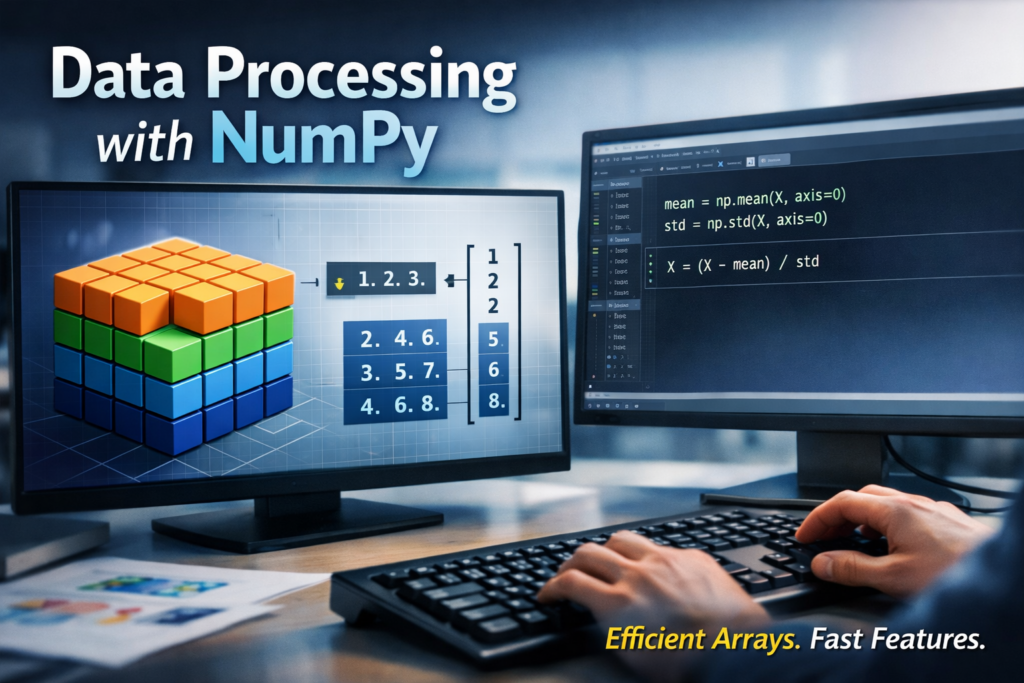
Efficient Numerical Computing and Array Operations Before any Machine Learning model, dashboard, or analytics pipeline is built, data must be processed and transformed efficiently.At the heart of almost every Python-based data workflow lies NumPy. NumPy provides:  High-performance numerical computation  Powerful multi-dimensional arrays  Vectorized operations (no slow Python loops)  The foundation for Pandas, SciPy, Scikit-learn, TensorFlow, …

Data Processing and Feature Engineering with NumPy Read More »

Data Processing and Feature Engineering with Pandas

Data Manipulation and Analysis for Machine Learning & Analytics Students In real-world data science and machine learning projects, data preparation consumes 70–80% of the total effort.Raw data is often: Incomplete Inconsistent Noisy Poorly structured This is where Data Processing and Feature Engineering come into play. Pandas, Python’s most powerful data manipulation library, provides everything needed …

Data Processing and Feature Engineering with Pandas Read More »

NumPy-like ML Libraries: JAX (by Google) & Theano (Legacy Research Library)

Modern machine learning relies on fast numerical computation, automatic differentiation, and efficient use of GPUs/TPUs. While NumPy remains the foundation for numerical Python programming, it lacks several advanced capabilities needed for training today’s deep learning models. This gap led to the creation of specialized ML libraries that feel like NumPy but go far beyond it. …

NumPy-like ML Libraries: JAX (by Google) & Theano (Legacy Research Library) Read More »