
Machine Learning can be powerful—but building the best model often requires deep expertise, experimentation, and time. From selecting the right algorithm to tuning hyperparameters and preprocessing data, the process can be complex and time-consuming.
This is where AutoML (Automated Machine Learning) tools like TPOT come in.
What is TPOT?
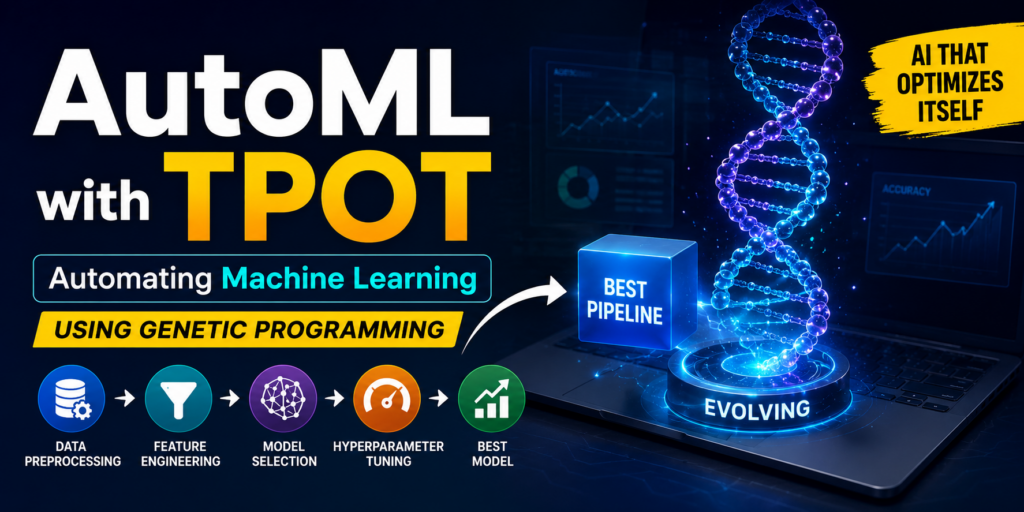
TPOT (Tree-based Pipeline Optimization Tool) is a Python AutoML library that uses Genetic Programming to automatically design and optimize machine learning pipelines.
Instead of manually trying different models and configurations, TPOT:
✔ Selects the best algorithms
✔ Optimizes hyperparameters
✔ Builds complete ML pipelines
✔ Improves models over generations
All with minimal human intervention.
How TPOT Works (Genetic Programming)
TPOT is inspired by the concept of natural evolution.
Here’s how it works step-by-step:
1. Initial Population
TPOT starts by generating a set of random machine learning pipelines.
2. Fitness Evaluation
Each pipeline is evaluated based on performance (e.g., accuracy, F1 score).
3. Selection
The best-performing pipelines are selected.
4. Crossover & Mutation
Pipelines are combined and modified to create new ones (like biological evolution).
5. Next Generation
The process repeats for multiple generations to find the best pipeline.
💡 Over time, TPOT evolves highly optimized solutions.
What is a Pipeline in TPOT?
A machine learning pipeline is a sequence of steps applied to data before training a model.
Typical steps include:
✔ Data preprocessing (scaling, normalization)
✔ Feature selection
✔ Model selection
✔ Hyperparameter tuning
TPOT automatically builds and optimizes this entire workflow.
Key Features of TPOT
✔ Fully Automated ML
No need to manually test multiple models.
✔ Pipeline Optimization
Finds the best combination of preprocessing + model.
✔ Uses Scikit-learn
Built on top of familiar tools like scikit-learn.
✔ Exportable Code
You can export the final pipeline as clean Python code.
✔ Flexible Configuration
Customize generations, population size, scoring metrics, etc.
Example: Using TPOT
Here’s a simple example:
from tpot import TPOTClassifier
from sklearn.datasets import load_iris
from sklearn.model_selection import train_test_split

# Load dataset
data = load_iris()
X_train, X_test, y_train, y_test = train_test_split(
    data.data, data.target, test_size=0.2
)

# Initialize TPOT
tpot = TPOTClassifier(
    generations=5,
    population_size=20,
    verbosity=2
)

# Train model
tpot.fit(X_train, y_train)

# Evaluate
print(tpot.score(X_test, y_test))

# Export best pipeline
tpot.export('best_pipeline.py')
Advantages of TPOT
✔ Saves Time
Automates trial-and-error process.
✔ Beginner-Friendly
Great for students starting with ML.
✔ Finds Hidden Patterns
May discover combinations humans might miss.
✔ Improves Productivity
Focus more on problem-solving than tuning.
Limitations of TPOT
❗ Computationally Expensive
Genetic algorithms require time and processing power.
❗ Less Interpretability
Pipelines can become complex.
❗ Not Always Optimal for All Cases
Manual tuning may still outperform in expert scenarios.
When Should You Use TPOT?
TPOT is ideal when:
✔ You are a beginner in ML
✔ You want quick baseline models
✔ You don’t know which algorithm to choose
✔ You want to automate experimentation
TPOT vs Traditional ML
| Feature | Traditional ML | TPOT AutoML |
|---|---|---|
| Model Selection | Manual | Automatic |
| Hyperparameter Tuning | Manual | Automatic |
| Pipeline Creation | Manual | Automatic |
| Time Required | High | Lower |
| Expertise Needed | High | Moderate/Low |
TPOT is a powerful AutoML tool that brings intelligence and automation into the machine learning workflow. By leveraging genetic programming, it can automatically discover high-performing pipelines with minimal effort.
For students and professionals alike, TPOT is an excellent way to:
✔ Learn how ML pipelines work
✔ Quickly build working models
✔ Understand the power of automation in AI
AutoML tools like TPOT are not here to replace data scientists—they are here to enhance productivity and accelerate innovation.
Start exploring TPOT and experience how machine learning can optimize itself
Happy Learning!